Mailgun’s AI email pitch puts delivery plumbing first
Mailgun argues that autonomous email needs more than a fast model: separate sending reputations, structured replies and infrastructure that keeps login codes moving.

By Owen Reyes· Email Vox · 21 Oct 2026
Key facts
- ■Mailgun says 79% of senders surveyed already use AI or plan to use it in their email programs.
- ■Mailgun’s Email Impact Report says 74% of high-volume senders already use some form of AI in production.
- ■Mailgun says its infrastructure delivers 99% of messages within 20 seconds; that claim is not a guarantee of inbox placement.
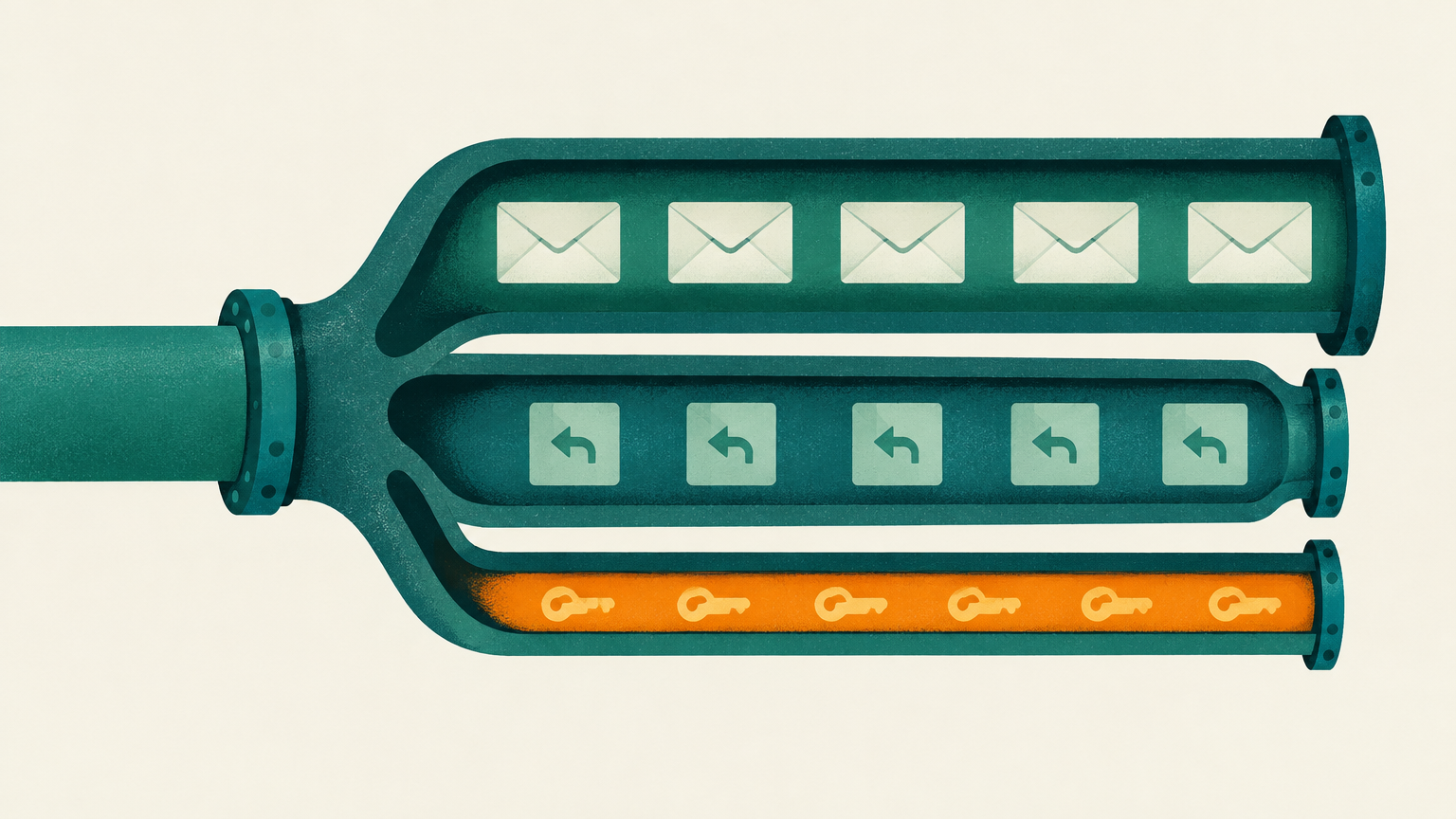
- ■Mailgun’s Multi-Tenant Engine separates sender reputations, application programming interface keys and dedicated IP addresses through subaccounts.
- ■Sinch’s AI Production Paradox report says 84% of AI engineering teams spend over half their time on safety controls, retries and infrastructure.
An AI agent can decide what to send in a flash. Getting that message to a person is a separate job. In a post about email infrastructure for AI products, Mailgun puts login messages, isolated sending reputations and machine-readable replies at the center of its pitch to developers.
The adoption numbers explain the sales push: Mailgun’s Email Impact Report says 79% of senders already use AI or plan to, while 74% of high-volume senders already use some form of AI in production. Those are different measures—not evidence that three-quarters of large senders have handed their email programs to autonomous agents.
What happened
Mailgun is positioning its delivery infrastructure as a supporting layer for AI applications, from adding a large language model to an existing software workflow to running agents that act without waiting for a prompt. The post describes capabilities and performance claims, rather than announcing a dated product launch.
Its main architectural proposal is separation. Mailgun says its Multi-Tenant Engine uses subaccounts to isolate sender reputations, application programming interface (API) keys and dedicated internet protocol (IP) addresses. The intended benefit is to keep one high-volume autonomous campaign from damaging delivery of verification messages and one-time passwords, or OTPs.
That distinction matters because the post puts promotional campaigns and account-access messages inside the same AI infrastructure discussion. They have different consequences when delivery goes wrong: a delayed campaign is not the same product problem as a user being unable to finish signing in. Mailgun presents separate sending infrastructure as a way to contain that exposure.
Mailgun also describes the return path. It says its inbound processing captures replies and turns Multipurpose Internet Mail Extensions (MIME) data into structured JavaScript Object Notation (JSON) payloads. That gives an application a more usable representation of incoming email, allowing a model to process a response and continue a workflow.
For speed, the company says 99% of messages are delivered in 20 seconds or less. Despite a section heading that invokes sub-second delivery, the numerical claim offered is the 20-second measure. The post does not provide a detailed measurement methodology, so readers should not treat it as a universal promise about when a recipient sees a message.
The background
Mailgun’s argument connects AI productivity to the less glamorous work of email deliverability. Its report says 46% of teams using AI in their email programs experienced increased speed and efficiency. Faster generation or decision-making, however, measures a different part of the workflow from transporting the finished message.
The company draws another number from Sinch’s AI Production Paradox report: 84% of AI engineering teams said they spend more than half their time building safety controls, retries and infrastructure instead of core product features. That statistic groups several kinds of engineering work together; it does not establish how much of that time is specifically spent on email.
Autonomous sending adds a control question that ordinary drafting tools do not answer. Mailgun describes agents choosing when to send, what to send and whom to contact. Once those decisions move into software, subaccount boundaries become relevant to limiting the consequences of a particular tenant’s or workflow’s activity—not simply organizing billing or credentials.
Reply processing introduces a separate distinction: structured data is easier to consume, but it is not automatically trustworthy. Our earlier coverage of hidden instructions targeting AI email assistants explains why incoming message content deserves its own safeguards. Mailgun’s MIME-to-JSON description addresses formatting; it does not establish protection against malicious instructions embedded in replies.
The performance evidence also needs careful reading. Mailgun says 54% of senders that integrated AI saw significant year-over-year improvement and says they outperformed non-AI users by 15%. The post does not explain whether that comparison means a relative percentage or percentage-point difference, and the figures alone do not establish that AI caused the improvement.
What people are saying
The source is a vendor argument, not a collection of customer reactions. Author Phil Kellum, a marketing manager and copywriter at Sinch Mailgun, calls the engineering burden a “guardrail tax.” His position is that managed delivery services can free developers to work on models and product features rather than rebuilding communications infrastructure.
To support the commercial case, Mailgun cites Forrester figures: an average $594,000 revenue increase tied to improved email performance, a 65% lift in open rates and a 21% lower bounce rate associated with form-level email validation. The post does not supply the study design, customer sample or assumptions needed to apply those numbers to another business.
The open-rate figure needs particular restraint. As our coverage of what email open tracking actually measures explains, pixel loads are not a clean count of human attention. A reported lift in opens should not be read as an equivalent increase in people reading, purchasing or successfully completing an AI-driven task.
Mailgun’s support proposition is more concrete: its Technical Account Manager team handles guided IP warming and proactive reputation monitoring. The company also advertises a 99.99% system uptime guarantee. System availability, message delivery speed and inbox placement describe different outcomes; the uptime figure does not promise all three.
What happens next
There is no rollout deadline in the post. Mailgun’s next step is commercial: inviting developers to discuss a custom high-volume plan. It also says 74% of enterprises reported rolling back live AI agents because of operational failures, but provides no breakdown showing how many failures involved email.
For teams evaluating the pitch, the useful next step is a workflow-level test rather than assuming the headline percentages will transfer. Measure account-access messages separately from campaigns, check what subaccounts actually isolate, and test how replies enter the model. Those checks map directly to the delivery, separation and inbound-processing capabilities Mailgun describes.
The scope of outsourcing deserves equal attention. Mailgun promotes compliance support alongside delivery tooling, but its post does not demonstrate that purchasing infrastructure removes the need for application-level safety controls. Developers still need to decide which sending actions an agent may take and what should happen when a reply or delivery attempt goes wrong.
The Email Vox take
Separate account-access mail from experimental autonomous campaigns before increasing volume. Ask vendors to demonstrate the boundaries around reputations, credentials and IP resources, rather than accepting “multi-tenant” as a complete answer.
Test delivery timing, reply handling and failure behavior with your own workflows. Keep incoming email untrusted even after it becomes JSON, and evaluate uptime, inbox placement and business outcomes separately. Vendor averages are useful questions to investigate—not your forecast.
Frequently asked questions
- what is Mailgun offering for AI email agents?
- Mailgun describes outbound delivery, subaccounts that separate sending resources, inbound reply conversion into structured JSON, and technical support. Its post positions these capabilities for AI applications rather than announcing a dated launch.
- how many email senders use AI?
- Mailgun’s Email Impact Report says 79% of senders use AI or plan to use it. It separately says 74% of high-volume senders already use some form of AI in production, not necessarily autonomous agents.
- how fast does Mailgun deliver email?
- Mailgun says 99% of messages are delivered within 20 seconds. The post does not provide detailed measurement methodology, and the claim should not be treated as a guarantee of inbox placement or recipient visibility.
- why separate AI campaigns from login emails?
- Mailgun presents separation as a way to prevent a high-volume autonomous campaign from damaging delivery of verification messages and one-time passwords. Its Multi-Tenant Engine uses subaccounts to isolate reputations, API keys and dedicated IP addresses.
- can Mailgun turn email replies into JSON?
- Mailgun says its inbound processing captures replies and converts MIME email data into structured JSON payloads that applications can process. That conversion addresses formatting; it does not establish that the reply’s contents are safe to follow.
- does Mailgun guarantee inbox placement?
- The post advertises a 99.99% system uptime guarantee and a separate delivery-speed claim. Neither should be read as an inbox-placement guarantee: availability, delivery timing and inbox placement measure different outcomes.
- does using AI prove an email program will perform better?
- No. Mailgun reports that 54% of AI adopters saw significant year-over-year improvement, but the figures presented do not establish causation or guarantee the same result for another sender.
Why this matters
AI email is becoming an infrastructure question as well as a content question. A system that chooses recipients and acts on replies ties delivery performance directly to product behavior: email is no longer just the final output. Mailgun’s pitch shows providers competing to supply that operational layer, including separation between workloads and a return path for responses. The important boundary is between making messages easier to move and making autonomous decisions safe. Better transport can support an AI product without settling every question about what that product should send.
Sources
Reporting draws on the public sources listed above. Spotted an error? Request a correction.
Follow-up coverage
Related coverage
Google adds Gmail reply controls to Workspace Studio
Workspace Studio’s October update adds reply filtering, nested logic, document search and more meeting data—small controls that could make email workflows less repetitive.
10 Oct 2026

Proofpoint bets $6.3B that email and data security belong together
$6.3 billion, all cash, one big bet: Proofpoint moves to fuse email, data, and AI security under a single roof. Here’s what changes for senders.
16 Oct 2026

Apple’s reported Mail changes put email clarity to the test
Validity’s September 2026 analysis describes foldable layouts and AI-assisted email retrieval—but its predictions for clicks and revenue remain predictions.
13 Oct 2026

Phish are now baiting your AI email assistant
Attackers are slipping hidden instructions into emails to steer AI assistants. Here’s how the trick works—and what to lock down before it bites.
15 Oct 2026

Mailgun shows how to send email alerts to Discord
A Python bridge turns Mailgun delivery events into Discord messages. The walkthrough covers setup and testing, but teams still need to choose what deserves an alert.
10 Oct 2026
DMARC just got real: a 4‑week plan to harden delivery
Vendors now make DMARC mandatory, blocklists are hotter, and TLS identity is shifting. Here’s a concrete tune‑up plan that meets the 2026 reality without drama.
21 Oct 2026